
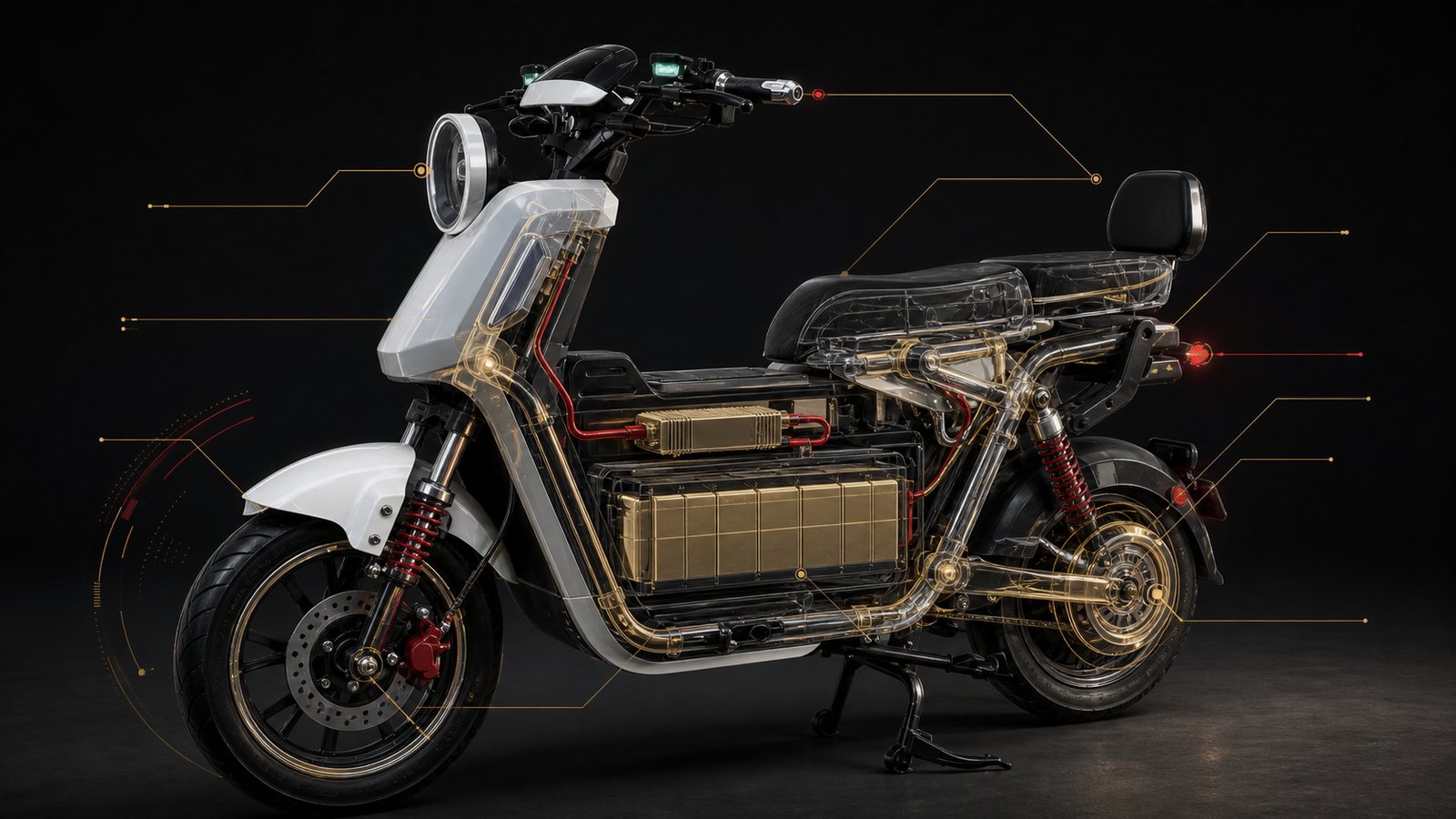
EVAROQ SYSTEM TECHNOLOGY
Engineered as
one electric system.
Drive, control, energy, structure and road contact are developed as one connected riding experience.
Conceptual technical visualization. Component layout varies by configuration.POPULAR S1 CONFIGURATION
Known hardware.
Clear purpose.
SYSTEM ARCHITECTURE
Six layers.
One ride.
Each layer has a distinct job. Together they shape response, stability, usability and everyday confidence.
Brushless electric drive
A compact electric drive delivers direct response with fewer routine mechanical service points than a combustion drivetrain.
Controller calibration
The 15-MOSFET controller manages power delivery. Final acceleration and speed behaviour are calibrated for the selected configuration.
Configurable energy
Lead-acid and lithium battery directions can support different priorities in cost, mass and usable energy, subject to the confirmed model specification.
Road contact
The 90/90–12 tubeless tyre format supports a broad contact patch and practical everyday road use.
Steel structure
A steel frame and steel rim provide the structural base for the popular S1 configuration.
Rider interface
Lighting, display and controls keep essential riding information and commands within immediate reach.
CONFIGURABLE ENERGY PLATFORM
Choose for the mission,
not the headline.
Battery choice should reflect route length, charging access, payload, climate, serviceability and target cost. EVAROQ confirms the final pack and documentation for each approved configuration.
Lead-acid direction
Lower initial cost and familiar servicing, with higher mass and lower energy density.
Lithium direction
Lower mass and higher energy density, with pack protection and transport documentation matched to the selected battery.
RESPONSIBLE URBAN MOBILITY
Cleaner at street level.
Honest about the whole journey.
Electric riding produces no tailpipe emissions during use and reduces drivetrain noise at street level. Total environmental impact still depends on electricity generation, battery production, product life and end-of-life handling.
- No tailpipe emissions while riding
- Lower electric drivetrain noise
- Configuration matched to real use
- Battery handling follows applicable local requirements